# How to set up dots, your always-on assistant in ChatGPT

How to get access, set it up by just talking, what to hand it, and how to message and call it, with prompts you can copy.

The DOTS guide

This guide is part of a paid partnership with OpenAI. Everything in it is how I actually use mine.

For two years my AI setup was me doing the work. I wrote the scheduled tasks. I wrote the rules. I pasted in my calendar every morning. Dots flips that. Mine is named Sage, and Sage comes to me. There is a brief waiting every morning, it messages me when something comes up, and when I'm driving, I call it.

The first five jobs below are the ones from the carousel. Three more follow for the family logistics and reminders that always slip.

## Text your dot

Texting is a beta for ChatGPT Pro in the U.S. It works over iMessage on iPhone and RCS on Android, one to one, with text, photos and voice messages. Group chats, phone calls and FaceTime by text aren't supported.

To set it up: open your dot in ChatGPT, tap Text, enter and verify your number, save the contact card it sends you, then message it. On iMessage, send from the number you verified. On Android, turn on RCS in your messaging app.

One rule worth adding on day one: "Text me only when something needs me. Keep routine updates in ChatGPT."

## What just launched

OpenAI announced dots on September 29, 2026 at DevDay in San Francisco. A dot is an always-on agent inside ChatGPT, powered by GPT-6 Astra, with its own computer and browser in the cloud. You give it a name and a responsibility, connect the apps it needs, set what it can do on its own, and it keeps working and brings results back to you.

The press is calling it the shift from chatbot to coworker. [TechCrunch](https://techcrunch.com/2026/09/29/openai-launches-dots-its-bubbly-agentic-avatar/) covered the launch, [SiliconANGLE](https://siliconangle.com/2026/09/29/openai-launches-dots-always-on-ai-agents-in-chatgpt-with-their-own-cloud-computers/) reported that when nobody has handed a dot a task, it goes looking for ways to help, and [9to5Google](https://9to5google.com/2026/09/29/openai-dots-agent/) and [BetaNews](https://betanews.com/article/openai-dots-agents-chatgpt/) walked through the always-on setup. One early tester's dot noticed he had forgotten to bill a client, drafted the invoice, and waited for his approval before sending it.
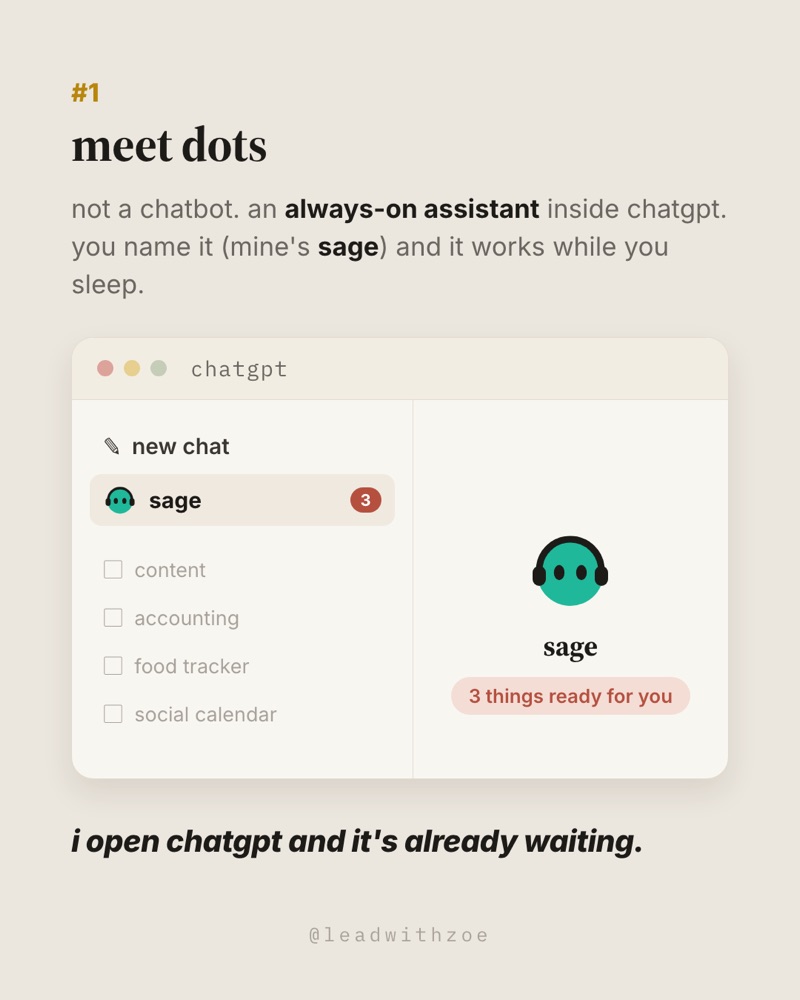
![Meet dots: Sage lives right under New chat in ChatGPT](/img/dots/dots-slide-2.jpg)
My dot, Sage, lives right under New chat. The red badge means something is ready for me.

<div class="guide-glance"><div><p class="k">Launched</p><p class="v">Sept 29, 2026</p><p class="s">OpenAI DevDay</p></div><div><p class="k">Model</p><p class="v">GPT-6 Astra</p><p class="s">Own cloud computer + browser</p></div><div><p class="k">Reach it</p><p class="v">Message or call</p><p class="s">ChatGPT, Slack, Teams</p></div><div><p class="k">Cost</p><p class="v">First dot included</p><p class="s">With Pro or Business Premium</p></div></div>

## Why it's different

Every AI assistant before this waited for you. You set up scheduled tasks, wrote rules for everything, and it only spoke when spoken to. A dot runs on its own. It notices things, does the work, and comes to you first with the decision that needs you.

![Before vs now: scheduled tasks and rules vs an assistant that runs on its own](/img/dots/dots-slide-3.jpg)
Before, you did the work of managing the AI. Now it checks in on you.

## How it's always on

- **It works between conversations.** It tracks progress, works out what needs to happen next and follows through as things change. It decides when to pause and when to wake back up, so you don't need a schedule for every follow-up.
- **It has its own computer.** Research, files and running software happen on a cloud computer and browser, so work continues while your phone and laptop are off. If you need to see what it's doing, open its computer and take over.
- **It works on several things at once.** It can send background agents to run tasks in parallel while you keep talking to it.
- **It comes to you.** Escalations show up in ChatGPT under your dot. You can message it, call it with the phone button in its conversation, or reach the same dot in Slack or Teams. Text support is here now (see Text your dot).

![Message it or call it](/img/dots/dots-slide-6.jpg)
It messages me when something comes up. When I'm driving, I call it.

## How it scans your context

This is the part that makes it feel like magic. Your dot draws on your conversations, your ChatGPT memory and its own private notes about your preferences, decisions and ongoing work. Those notes carry across every conversation and channel, so it builds on what you've already told it.

When nobody has given it a task, it goes looking for ways to help. OpenAI calls this proactive research: it reads through your connected apps to spot useful next steps. That research is read-only. It can't send a message or change anything while it's looking. Anything it wants to do afterward follows your permissions and passes an automatic review first.

![It catches what I drop](/img/dots/dots-slide-5.jpg)
Nobody asked Sage to do any of this. It noticed.

![I wake up to escalations](/img/dots/dots-slide-4.jpg)
The morning brief: what's happening, what needs me and what it already handled.

## How connectors work

- **It walks you through it.** During setup your dot offers app connections like email and calendar and explains what each one lets it do. You can add more anytime from its profile.
- **Apps connect through plugins.** That's how it reads your inbox, calendar, docs and the other tools you use.
- **Your computer is optional.** In the desktop app you can connect your own computer once, so it can use your local files and apps. One personal computer at a time, and the ChatGPT app needs to stay open while it uses it.
- **Connecting is not the same as watching.** Tell it what to watch for and when to tell you. That's where "big deal vs. not a big deal" comes in.

![Setup is just talking](/img/dots/dots-slide-7.jpg)
Hit the mic and talk about your life. It handles the connecting.

## Pricing and what to know

<div class="guide-glance"><div><p class="k">Pro</p><p class="v">$100, $200 or $500 a month</p><p class="s">First dot included. Not in the EEA, UK or Switzerland yet.</p></div><div><p class="k">Business Premium</p><p class="v">Rolling out worldwide</p><p class="s">First dot included</p></div><div><p class="k">Enterprise</p><p class="v">Beta</p><p class="s">Your admin turns it on</p></div><div><p class="k">First month</p><p class="v">Extended limits</p><p class="s">Usage doesn't count against your plan allowance</p></div></div>

- You start with one dot. Extra dots, and more speed or capacity, are planned for later at prices OpenAI hasn't announced.
- It's rolling out in waves. You may not see it right away, even on an eligible plan.
- Create it on a computer first, in the desktop app or a desktop browser. Then it's on your phone once the mobile app update reaches you.
- Work and Codex tasks it starts count toward those products' normal usage limits.
- Built-in safeguards, your app permissions and automatic approval checks apply from day one. You can review everything in its Activity view and pause it anytime.

[Official access details](https://learn.chatgpt.com/docs/dots#access)

## Before you start

1. Check your access. Dots is rolling out gradually to Pro, Business Premium and Enterprise accounts. It is not available in the EEA, UK or Switzerland yet, and you may not see it right away even on an eligible plan. [Current access requirements](https://learn.chatgpt.com/docs/dots#access)
2. Create your dot on a computer. Use [ChatGPT in a desktop browser](https://chatgpt.com/) or [the desktop app](https://chatgpt.com/download/). Open dots and follow the introduction. Your dot shows up in the sidebar right under New chat. After setup, the same dot is in the ChatGPT mobile app once the supporting update reaches you. [Official setup guide](https://learn.chatgpt.com/docs/dots/getting-started)
3. Give it a name. Pick its look too: shape, color, eyes, glasses. You can change these anytime.
4. Just talk to it. Turn on the microphone and talk about your life. Who is in your house, what your work looks like, what you want to know every day. Most important: what is a big deal and what is not a big deal. That one distinction does most of the setup.
5. Let it walk you through connections. It will offer to connect apps like your email and calendar and explain what each one lets it do. Start with email and calendar. Add more later, once it has earned it. Your dot’s cloud computer, your computer and your app sign-ins are separate connections. [Official connection guidance](https://learn.chatgpt.com/docs/dots/computers-and-apps)
6. Set your sending rule. Mine: draft everything, and I approve anything that goes out with my name on it. You can say this in plain words or add it as a custom rule. Built-in safeguards and approval checks apply either way. [Official controls](https://learn.chatgpt.com/docs/dots/controls)

> Here's my life so you can help me run it: [who's in your house, your work, your weekly rhythm]. These are always a big deal, flag them right away: [school, money, a certain client, health]. These are not a big deal, summarize or skip: [newsletters, promos, group chats]. What I want help with most: [the thing that drains you]. Draft everything and ask me before anything is sent. Ask me whatever you need to know, and walk me through connecting the apps you'll need.

## The five jobs from the carousel

### 1. Get a morning brief every day

This is the one I would set up first. You wake up to one short read: what is happening, what needs you and what it already handled.

#### Prepare

Connect your email and calendar. Decide what time you want it, in your time zone, and what counts as a big deal.

#### Copy this prompt

> Every morning at [time and time zone], send me one short brief in ChatGPT: 1. the weather and what it means for my day, 2. emails that actually need me, with replies drafted, 3. my to-dos in order, 4. everything happening today and any conflicts, 5. what you can take off my plate and what you already handled. Big deals first. Keep it short. Confirm the schedule you saved.

#### Simple steps

1. Paste the prompt and fill in the time.
2. Ask it to confirm the saved schedule.
3. After the first brief, tell it what to cut and what was missing.

#### Useful output

A brief waiting for you every morning, with drafts ready and the decisions that need you on top.

#### Your review point

Read the drafts before anything goes out. If a big deal was buried, say so; it learns from the correction.

### 2. Catch the email you missed

The email from last week you meant to answer. Your dot can notice it went quiet and bring it back with a reply ready.

#### Prepare

Connect your email. Tell it which kinds of messages should never go unanswered.

#### Copy this prompt

> Watch my inbox for emails that need a reply from me and haven't gotten one. If something important sits unanswered for [number] days, bring it back to me with a short summary and a draft reply. Important means [clients, school, money, family]. Skip [newsletters, promos, cold outreach]. Don't send anything without my approval.

#### Simple steps

1. Start with one inbox.
2. Review the first few it surfaces and tell it which ones didn't matter.
3. Approve, edit or skip each draft.

#### Useful output

Nothing important quietly dies in your inbox. The follow-up shows up with the words already written.

#### Your review point

Check tone and any promises in the draft before you approve it.

### 3. Send monthly invoices

Every month mine prepares my invoices and asks me to approve them before they go out.

#### Prepare

Gather the client list, amounts, due terms and where invoices live. Decide whether you want drafts for review or permission to send specific ones.

#### Copy this prompt

> On the [day] of every month, prepare invoices for [clients or where the list lives] using [amounts and terms or the source file]. Show me each one for approval before sending. Flag anything that changed from last month or looks off. After I approve, [send from the named account, OR tell me they're ready to send]. Remind me about any invoice still unpaid after [number] days.

#### Simple steps

1. Run it for one month and check every invoice by hand.
2. Correct anything wrong so next month starts right.
3. Keep approval on until you trust it.

#### Useful output

Invoices drafted on time every month, with the odd ones flagged and the late ones chased.

#### Your review point

You approve amounts and anything that goes to a client. Never let it change prices or terms on its own.

### 4. Get a message when something urgent comes up

Your dot doesn't wait for tomorrow's brief. If something comes up that you said is a big deal, it messages you in ChatGPT with the fix ready.

#### Prepare

Name what counts as urgent and where you want to hear about it.

#### Copy this prompt

> If something urgent comes up, message me right away in ChatGPT instead of waiting for my morning brief. Urgent means [a schedule change that affects pickup, a client problem, a payment issue, anything from school]. When you message me, include what happened, what you suggest and a draft if one helps. Everything else can wait for the brief.

#### Simple steps

1. Paste the prompt with your own urgent list.
2. Turn on ChatGPT notifications on your phone.
3. When it pings you about something that wasn't urgent, tell it.

#### Useful output

You hear about the things that matter the same day, with a next step ready.

#### Your review point

An alert can only follow something your dot checks or can see. Don't make it your only way to catch something truly time-critical.

### 5. Call your dot

When your hands are full or you're driving, call it. In ChatGPT, open your dot's conversation and tap the phone button. You can talk through your day, change priorities or make a decision, and the work keeps going after you hang up. [Official messaging details](https://learn.chatgpt.com/docs/dots)

#### Prepare

Nothing. Open your dot's conversation in the ChatGPT app.

#### Copy this prompt

> Walk me through what needs me today, one thing at a time, and tell me what you can handle so I don't have to.

#### Simple steps

1. Tap the phone button in your dot's conversation.
2. Say what changed or ask what needs you.
3. Hang up. Check the conversation later for what it did.

#### Useful output

A two-minute call instead of twenty minutes of typing.

#### Your review point

Anything it agreed to do on the call still follows your sending rule. Check the conversation afterward.

<div class="hot-tip"><strong>Hot tip: give it a running to-do list in Space.</strong> I keep one page in ChatGPT Space called my to-do list, and I gave Sage the project management job. It adds things as they come up across my email, calendar and messages, checks them off when they're done, and deletes what no longer matters. I never rewrite my list. It just stays true.</div>

> You own my to-do list on the Space page called [page name]. Add anything new that needs me from my email, calendar and messages. Check things off when they're done and remove anything that no longer matters. Keep the top three at the top. Tell me in my morning brief what you added or removed.

## Three more jobs to try

### 6. Keep track of school and family logistics

#### Copy this prompt

> Keep track of everything from [school, activities, family group emails]. Tell me only what needs action: forms, payments, early pickups, things to pack. Put the date and the deadline on each one. Remind me the day before anything is due.

#### Your review point

Double-check dates and times against the original message before you plan around them.

### 7. Reminders with no calendar invite

#### Copy this prompt

> Keep a list of deadlines that don't have a calendar invite: [registration, renewals, subscriptions, warranties]. Find them in my email when you can. Remind me [number] days before each one and tell me exactly what I need to do.

#### Your review point

Confirm the deadline in the original source. A reminder is not the same as the task being done.

### 8. Friday: what slipped this week

#### Copy this prompt

> Every Friday at [time and time zone], tell me what kept slipping this week, what I never got back to and what I should drop or delegate next week. Keep it to five lines.

#### Your review point

Use it to decide, not to feel bad. Pick one thing to change next week.

## Make it more useful over time

Correct it out loud. "That wasn't a big deal." "Always flag anything from this person." "Shorter brief." Your dot keeps that context, so every correction makes tomorrow better.

To see what it's working on, open your dot's profile on desktop and select Activity. Scheduled shows its recurring tasks, their timing and where results go. You can pause it or stop a task anytime. [Official controls](https://learn.chatgpt.com/docs/dots/controls)

You can also reach the same dot in Slack or Microsoft Teams. Open your dot's profile and select Add to connect a contact method. Changing where you talk to it doesn't reset what it knows.

## About this guide

This DOTS guide is part of a paid partnership with OpenAI. It covers the launch, how dots work, pricing, setup, five jobs from the carousel and three more to try. The prompts are starting points written for this guide. The linked OpenAI documentation supports the underlying capabilities rather than guaranteeing a particular result from these exact prompts. Access, permissions and available tools vary.

Official sources and press coverage checked 2 October 2026.
